Problematic Situation
In El Salvador, only 20.2% of households have a car (DIGESTYC-MINEC, 2020). Therefore, the primary mean of transport is the public bus. However, the quality of this mean is quite poor. On the one hand, 72.43% of the buses and minibusses in El Salvador have ten or more years of manufacture. In addition, just over 10% of these units have only one and two years left to meet the maximum term of twenty years of utility, under the provisions of the Law of Land Transportation, Traffic and Road Safety (Peñate, 2019). This without considering the environmental pollution of public transport buses. On the other hand, being a public transport user means being exposed to assaults, sexual harassment, and other crime. For public bus drivers, the risk is in being assassinated if the gang extortion is not paid. When it comes to taxi service, drivers generally charge too high fees, have cars in poor condition, and provide poor customer service.
In the previously described context, the Uber app arrived in El Salvador in the first quarter of 2017. Uber is an innovative digital platform born in the United States and has a presence in multiple countries worldwide. This app offers drivers available to make trips requested through its mobile application. The main payment methods are electronic, but it also accepts cash. Uber rates typically vary by country and are based on factors such as travel distance, current traffic, and more. Given the deficiencies of Salvadoran public transport, Uber represented from the beginning a quality, safe and cheap alternative to travel. Nevertheless, it is necessary to analyze the advantages and disadvantages of Uber in El Salvador’s reality. The following analysis will be according to a technology assessment matrix. The analysis will start from various relevant criteria for sustainable and inclusive socio-economic development. For this purpose, quantitative and qualitative information will be used.
Matriz for technology assessment for Uber in El Salvador
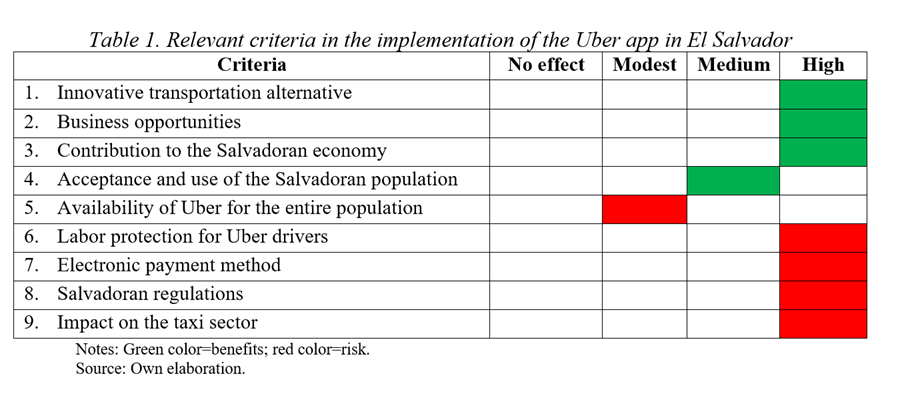
- Innovative transportation alternative. Uber’s business model was revolutionary in El Salvador and in every country where it has a presence. The insecurity and inadequate public transportation in this country provided the conditions for its success. At its launch in 2017, Uber El Salvador had 1,000 driving partners and 33,000 users. Now, the company reports 6,100 driver-partners and 233,000 users (Urquilla, 2020). The number of its driving partners has grown 510% and its users 606% in more than three years.
- Business opportunities. The success of Uber has driven the use of applications of this type. Now, there are similar applications like InDriver. The business model has expanded to apps for food delivery, such as the Salvadoran Hugo App. Besides, some apps offer the sale of sundries, medicines, errands, and more, which was vital during the quarantine by the Covid- 19. Soon, AllTruck, a similar Costa Rican digital platform applied to cargo transportation and logistics, will enter the Salvadoran market (Barrera, 2021).
- Contribution to the Salvadoran economy. The era of the Fourth Industrial Revolution and the rise of digitization boost the sharing economy’s profitability. In 2019, the income of the digital economy in El Salvador was US$2.8 billion. The online mobility services market, which includes Uber, had the largest share (21% of total revenue) (IADB, 2020). Furthermore, Uber is an employment opportunity for the unemployed population or in search of an extra job. It is estimated that in 2019 this company generated economic income equivalent to half of the formal jobs generated in El Salvador (Alemán, 2020).
- Acceptance and use of the Salvadoran population. The use of Uber has grown significantly. In the beginning, the Salvadoran population was not sure that an unknown driver would take them from one place to another, but its acceptance and use have increased substantially.
- Availability of Uber for the entire population. Uber only operates in the three largest cities in El Salvador and drivers cancel requests for trips to destinations in neighborhoods considered unsafe. Furthermore, only 23.4% of Salvadoran households have internet access (DIGESTYC-MINEC, 2020). Therefore, the number of people who can access this service is limited. These two situations can be considered a way of social exclusion since they both are structural factors the limit the access for everyone.
- Labor protection for Uber drivers. As in the rest of the world’s countries, the business model of this app violates labor rights. The company states that they do not have a contractual relationship with the drivers because they are independent workers. Thus, Uber drivers in El Salvador do not have access to employment benefits such as minimum wage, health insurance, pensions, or a Christmas bonus. This situation is even more worrisome, given that 70% of the Salvadoran workforce is in the informal sector (DIGESTYC-MINEC, 2020). Furthermore, globally El Salvador has a disadvantageous position in its labor market regulatory framework (#127 out of 180 countries in the 2020 Index of Economic Freedom) (The Heritage Foundation, 2020). This lack of protection is detrimental to well-being and labor rights like Uber drivers.
- Electronic payment method. It is difficult for Salvadoran Uber drivers to receive electronic payments (with debit or credit card). They prefer payments in cash because they need money available to cover their expenses (like gas and food) and pay the vehicle’s rental if it is not their own. For this reason, they reject requests for travel with cash payment. This situation has annoyed users, and Uber is implementing technologies that have decreased travel cancellations by payment method (Urquilla, 2020). Nevertheless, this is a clear example that Uber drivers have precarious living conditions and need to have money at hand, because they live day to day from the income generated in this job.
- Salvadoran regulations. El Salvador’s regulations are obsolete for the new context of information and communication technologies. The country ranks #124 out of 141 countries in the Legal framework’s adaptability to digital business models indicator of the Global Competitiveness Index 2019 (World Economic Forum, 2019). Thus, digital platform companies like Uber have hard times for establishing legally. In this case, the Law of Land Transportation, Traffic and Road Safety establishes a severe offense, whose fine amounts to US$57.14, due to the transport of people in a commercial function without authorization (Forbes México, 2017). Nowadays, Uber is not completely legal in El Salvador. However, it has been impossible to stop advancing these business models that are undeniably here to stay.
- Impact on the taxi sector. Uber came to El Salvador to compete directly with taxi drivers. Uber’s significantly low fares (beginning at US$ 1.50) compared to taxis (from US$ 3-5 minimum), lack of payment of taxes and driving license give Uber drivers an advantage over taxi drivers. For these reasons, hundreds of taxi drivers have protested on various occasions in the Salvadoran Congress (EFE, 2018).
Reflection on the role of Uber for sustainable and inclusive development in El Salvador
The implementation of Uber’s business model is still controversial around the world. The matrix for technology assessment reflects that most of the criteria have a risky impact. However, the previous information adds relevant data for the context of a developing country like El Salvador. From this, it is concluded that:
- Uber, both in El Salvador and worldwide, represents the resistance and debates of various actors to new technology. It reflects that “technologies and engineering solutions are generated at a rate faster than society can design new complementary institution” (Juma, 2016). Hence, governments have difficulties updating their regulatory frameworks according to new business models of the collaborative economy. In this case, tensions arise between the taxi drivers’ union due to Uber’s threat to its business’s sustainability. Also, labor market regulations conflict to protect drivers on this digital platform.
- The era of the Fourth Industrial Revolution, a period characterized by the rise of technologies and digitization, undeniably impacts social, economic, and regulatory areas. Therefore, it is necessary to conciliate the various spheres to take advantage of the potential that new technologies provide to generate development. In this case, business models, government regulation, labor rights, equal access to new technologies and fair market conditions need to conciliate.
- This conciliation process must be focused on sustainable and inclusive development. That is, to ensure that progress is environmentally and financially feasible in the present, without putting the future at risk. On the one hand, the insertion of new technologies can contribute to widening social inequalities and social exclusion. Thus, those with easy access to technologies might have greater well-being and growth opportunities than those who do not. Furthermore, guaranteeing the protection of the population’s rights, in this case, labor rights, is crucial for inclusive development.
- Finally, it is difficult to stop the rapid and constant technological progress. Above all, it is even more complicated because innovations and new technologies have come to stay in Salvadoran society and worldwide. Therefore, it is imperative to establish dialogue mechanisms that strengthen social cohesion. The goal should be to seize opportunities (such as new businesses and their contribution to the economy) while addressing the weaknesses and risks (unfair competition conditions, social exclusion, and outdated laws).
References
Alemán, U. (2020, February 5). Viaje de Uber llega a su fin en Colombia ¿Qué pasará en El Salvador? El Mundo. Retrieved February 20, 2021, from https://diario.elmundo.sv/viaje-de-uber-llega-a-su-fin-en-colombia-que-pasara-en-el-salvador/
Barrera, J. (2021, February 12). AllTruck, el “uber” de los fletes, extiende su operación en El Salvador. El Mundo. Retrieved February 20, 2021, from https://diario.elmundo.sv/alltruck-el-uber-de-los-fletes-extiende-su-operacion-en-el-salvador/
DIGESTYC-MINEC. (2020). Encuesta de Hogares de Propósitos Múltiples 2019. San Salvador. Recuperado el 18 de February de 2021, de http://www.digestyc.gob.sv/index.php/temas/des/ehpm/publicaciones-ehpm.html
EFE. (29 de January de 2018). Cientos de taxistas protestan contra la legalización de Uber en El Salvador. Recuperado el 19 de February de 2021, de https://www.efe.com/efe/america/sociedad/cientos-de-taxistas-protestan-contra-la-legalizacion-uber-en-el-salvador/20000013-3507662
Forbes México. (2017, November 10). Gobierno de El Salvador quiere regular a Uber. Retrieved February 19, 2021, from https://www.forbes.com.mx/gobierno-de-el-salvador-quiere-regular-a-uber/
IADB. (2020, October). A un clic de la transición: Economía Digital en Centroamérica y la República Dominicana. Retrieved February 20, 2021, from https://publications.iadb.org/publications/spanish/document/A-un-clic-de-la-transicion-Economia-digital-en-Centroamerica-y-la-Republica-Dominicana.pdf
Juma, C. (2016). Gales of Creative Distruction. En C. Juma, Innovation and Its Enemies: Why People Resist New Technologies. New York: Oxford University Press.
Peñate, S. (21 de January de 2019). Más del 70 % del transporte público está a media vida. La Prensa Gráfica. Recuperado el 18 de February de 2021, de https://www.laprensagrafica.com/elsalvador/Mas-del-70–del-transporte-publico-esta-a-media-vida-20190120-0279.html
The Heritage Foundation. (2020). 2020 Index of Economic Freedom. Washington DC. Obtenido de https://www.heritage.org/index/pdf/2020/book/Index_2020.pdf
Urquilla, K. (2020, November 8). Uber detecta conductores que condicionan método de pago. El Diario de Hoy. Retrieved February 18, 2021, from https://m.elsalvador.com/noticias/negocios/uber-detecta-conductores-condicionan-metodo-pago/773629/2020/
World Economic Forum. (2019). Global Competitiveness Report 2019: How to end a lost decade of productivity growth. Cologny/Geneva. Recuperado el 19 de February de 2021, de http://www3.weforum.org/docs/WEF_TheGlobalCompetitivenessReport2019.pdf
 Enner Martínez
Leave a comment